The recent accelerating changes in electronics technology, combined with lower initial costs of ownership and planned obsolescence, have caused a high rate of turnover for all types of electronic products. The replaced electronic products and systems that were made obsolete by new technologies are creating a fast-growing problem of ever increasing amounts of obsolete electronic gear that is accumulating around the globe.
In the United States, homeowner purchases of the new space saving LCD flat screen computer monitors and the new high definition LCD, plasma, and DLP television sets have made the older cathode ray tube (CRT) monitors and television sets obsolete but very difficult to dispose of. These old style CRT type monitors and television sets usually cannot legally be tossed into the trash to be disposed of in landfills, so they end up being stored in attics, closets, in storage buildings, or in the garage at home. Most of us get a new cell phone every year or so and the old cell phones, with their batteries still installed, get tossed into a drawer at home. All of this obsolete electronic equipment is being identified by a new term, e-waste.
Business organizations can face an even more daunting e-waste situation since they may replace hundreds of desktop or laptop computers, cell phones, or printers at a time and the old units have little or no trade-in value. Many businesses have rented storage space just to have a place to stack their obsolete computer gear, printers, fax machines, and other office equipment. The National Safety Council estimates that more than 150 million obsolete PCs are gathering dust in warehouses, storerooms, and closets as they await decisions on disposal. In addition, these old units must be purged of any company related data or information that might be stored on or retrievable from the hard drives. Depending on the methodology, hard drive destruction can cost from $30 to $80 per unit in order to guarantee that no data can be retrieved from the unit.
New industries are being created to recycle old computer systems and other e-waste. If your electronic equipment is too old to be refurbished and used, or is broken beyond repair, you may send it to one of the many companies that specialize in disassembling electronics, salvaging parts, and selling reclaimed materials. Many types of electronic equipment, such as computers, monitors, printers, and scanners, contain materials that can be reclaimed and used in producing new products. These materials include plastic, glass, steel, lead, tin, aluminum, copper, gold, silver, and other metals. Both refurbishing and recycling can be very labor intensive so you may have to actually pay a company to have your obsolete electronic gear processed in addition to the shipping costs to send the obsolete equipment to them.
The Waste Electrical and Electronic Equipment (WEEE) regulations governing the safe disposal of electronic equipment were finally passed into law in the European Union. The new legislation came into full effect in July of 2006 along with new requirements on the Restrictions on Hazardous Substances (RoHS). The new WEEE regulations will place a greater administrative burden on suppliers of electronic equipment to EU countries. Vendors will have to register with waste schemes and more closely track their products in order to pay for those products' eventual disposal.
Under the new law, manufacturers selling into the European Union had until March 15, 2005 to register with approved disposal schemes, and by August 13, 2005, all new equipment sold in the European Union was required to be marked with WEEE labels displaying a date code and the standard logo of a crossed-out trash bin. The RoHS directive came into full effect for the European Union on July 1, 2006 with producers taking responsibility for treating and recycling household and business waste electrical and electronic equipment. In the United Kingdom, the dates for WEEE implementation were delayed but are listed below:
January 31, 2007: Deadline for compliance schemes to apply for approval
February 28, 2007: Deadline for schemes to be approved
March 31, 2007: Deadline for producers/schemes to register
July of 2007: Full producer responsibility for WEEE begins
The WEEE directives for the European Union are setting the stage for future e-waste related debates around the globe, including this year in China, Japan, and South Korea. Similar laws and regulations to the WEEE are being considered now in the United States as Congress debates a number of e-waste management bills. All of these are currently still stalled in committee, but several states have proactively passed their own laws governing e-waste management. California was the first state to enact such legislation (Electronic Waste Recycling Act SB20), followed by Maryland, Maine and Washington.
The Toshiba Corporation has recently announced an enhancement to their recycling plan for laptop computers. Toshiba offers free recycling of all Toshiba notebooks as well as low-cost recycling options for other manufacturer laptops and consumer electronics products. Through its trade-in program, Toshiba also provides customers the opportunity to extend the life of their laptop or other consumer electronic product by trading it in for its cash value."
The Toshiba trade-in and recycling program allows you to trade-in the old technology products you have for the new cutting-edge Toshiba computer technology you want! Regardless of the brand, trade-in used consumer electronic products that still have a monetary value for a refund by mail. If the product is no longer functioning or has no trade-in value, it can be responsibly recycled for the cost of shipping. Recycling of all Toshiba notebooks is free! Whether your pocket book gets a little thicker or landfills get a little leaner, with the Toshiba Trade-in and Recycling Program, everyone wins.
http://www.website-articles.net/Article/Are-You-Becoming-E-Wasted-/4582
Thursday, September 27, 2007
Stay Up-to-Date with Quality Cell Phones where New Product Lines are Continuously Added
Cell phones and their accessories are constantly changing and becoming more advanced. If your cell phone no longer meets your needs it might be time to look for a new one. Whatever your cell phone needs, you will be able to find the latest products online. New product lines are continuously added to offer you the best in quality products.
Cell Phone Uses
Cell phones are no longer used just to make a quick call. Many businesses use them for their main lines because they are portable and have superior reception. Text messaging has become popular with cell phone users because of the ease of use and convenience. Many new cell phones will feature cameras and video abilities to use for work or fun.
New Product Lines Are Continuously Added
Shopping online for a cell phone will impart to you the most unique selection of products and quality services. New product lines are continuously added to help you stay up to date on current products. If you are looking for a certain product you can go to your search engine and type in the key words. You will find numerous sites to look at and compare products.
There are many online malls that offer a wide variety of products and different brands. They also offer countless other products so you can do all your shopping on one site. Many offer wholesale or discount prices and make it worthwhile to check out their sites. To stay up to date and offer competitive merchandise such as cell phones, new product lines are continuously added.
Popular Cell Phones
With the heightened use of the Internet, the Skype phones have become more prevalent. With the new Netgear Skype WiFi Phone, you can make calls to anyone with a Skype phone anywhere in the world. You don't have to be connected to your PC when you have access to the WiFi network. You can even call ordinary phones for a small fee.
The Bluetooth products are popular because of their wireless features. Hands free use makes this phone ideal for active people and those who have to constantly be multi-tasked. There are assorted accessories for these phones to make it more convenient in your situation.
Find the Cell Phone You Want
Cell phones vary in price according to the features that are included. You can buy a quality phone for under a hundred dollars but can go higher for the advanced functions that you desire. Look for the online sites with a unique selection of products and quality services.
As you shop for your new cell phone, you will find many other products that are compatible with the phones. You can purchase these along with your phone and have all the components that are made to use together. Where new product lines are continuously added, you'll be able to find the cell phone that's right for you any time of the year.
http://www.website-articles.net/Article/Stay-Up-to-Date-with-Quality-Cell-Phones-where-New-Product-Lines-are-Continuously-Added/4009
Cell Phone Uses
Cell phones are no longer used just to make a quick call. Many businesses use them for their main lines because they are portable and have superior reception. Text messaging has become popular with cell phone users because of the ease of use and convenience. Many new cell phones will feature cameras and video abilities to use for work or fun.
New Product Lines Are Continuously Added
Shopping online for a cell phone will impart to you the most unique selection of products and quality services. New product lines are continuously added to help you stay up to date on current products. If you are looking for a certain product you can go to your search engine and type in the key words. You will find numerous sites to look at and compare products.
There are many online malls that offer a wide variety of products and different brands. They also offer countless other products so you can do all your shopping on one site. Many offer wholesale or discount prices and make it worthwhile to check out their sites. To stay up to date and offer competitive merchandise such as cell phones, new product lines are continuously added.
Popular Cell Phones
With the heightened use of the Internet, the Skype phones have become more prevalent. With the new Netgear Skype WiFi Phone, you can make calls to anyone with a Skype phone anywhere in the world. You don't have to be connected to your PC when you have access to the WiFi network. You can even call ordinary phones for a small fee.
The Bluetooth products are popular because of their wireless features. Hands free use makes this phone ideal for active people and those who have to constantly be multi-tasked. There are assorted accessories for these phones to make it more convenient in your situation.
Find the Cell Phone You Want
Cell phones vary in price according to the features that are included. You can buy a quality phone for under a hundred dollars but can go higher for the advanced functions that you desire. Look for the online sites with a unique selection of products and quality services.
As you shop for your new cell phone, you will find many other products that are compatible with the phones. You can purchase these along with your phone and have all the components that are made to use together. Where new product lines are continuously added, you'll be able to find the cell phone that's right for you any time of the year.
http://www.website-articles.net/Article/Stay-Up-to-Date-with-Quality-Cell-Phones-where-New-Product-Lines-are-Continuously-Added/4009

Capture all Your Daring Feats with a Helmet Camera
If you're the adventure type, helmet cameras can help you capture all those daring feats easily for motocross, flying, ATV, road racing, kayaking, skydiving, cycling, snowboarding, karting, and other adrenalin-pumping sports.
Helmet cams give you the capability to record every moment of the action without depending on an outside cameraperson. These action video cameras are popular with television and movie recordings as well as daredevil athletes, and now you can record your feats just like the pros! You can show the recording to your friends, and they can imagine being there with you on every twist and turn.
What is a Helmet Camera?
A helmet camera is a very small type of camcorder that can be attached to a protective helmet to record all the action while doing extreme sports activities. It can also be used for more relaxed sports such as fishing, golf, hiking, and biking. Helmet cameras are also called helmet cam, bullet cam or bullet camera, lipstick cam or lipstick camera (resembles a tube of lipstick), or wireless helmet camera.
A helmet camera works in conjunction with a DVR (DVD video recorder) and can be played back again and again for your enjoyment.
Benefits of Helmet Cams
Helmet cams provide hands-free recording during your extreme sports activity. This promotes safety and easy use. You won't have to worry about holding the camera or adjusting it as you go. You can concentrate on the activity and still capture all the details without distraction. Also, you can record sound with a helmet camera and narrate the activity as you go. If you're participating in an extreme sporting competition, you can record every moment as a keepsake for years to come.
Buying Helmet Cameras
When you get ready to buy a helmet camera, check online for a dependable retailer. You can always find great deals on quality lipstick cameras with all the accessories to go along. Search for helmet or bullet camera reviews to find good quality products. Also, check for sound quality, durability, and features before buying. Sometimes paying a little more is well worth it if you get a better quality helmet camera. There are affordable, high-quality cameras available online such as the Oregon Scientific ATC-2000 action adventure cam.
Tips for Using Helmet Cameras
Once you buy a helmet camera, take time to study on how to use it properly. Be sure the helmet cam has been properly secured before starting your activity. High speeds, bumps, and falls can cause the helmet camera to become lost or broken if you don't secure it properly. The camera's cable should also be secured so that it doesn't flap in the wind. Take quick breaks to check the lens to make sure it's clean if you're out on the road or in the dirt, water, or mud. Also, be sure the camera is actually recording before getting started!
During extreme sports, you can be the star every time with an amazing helmet camera!
http://www.website-articles.net/Article/Capture-all-Your-Daring-Feats-with-a-Helmet-Camera/9797
Helmet cams give you the capability to record every moment of the action without depending on an outside cameraperson. These action video cameras are popular with television and movie recordings as well as daredevil athletes, and now you can record your feats just like the pros! You can show the recording to your friends, and they can imagine being there with you on every twist and turn.
What is a Helmet Camera?
A helmet camera is a very small type of camcorder that can be attached to a protective helmet to record all the action while doing extreme sports activities. It can also be used for more relaxed sports such as fishing, golf, hiking, and biking. Helmet cameras are also called helmet cam, bullet cam or bullet camera, lipstick cam or lipstick camera (resembles a tube of lipstick), or wireless helmet camera.
A helmet camera works in conjunction with a DVR (DVD video recorder) and can be played back again and again for your enjoyment.
Benefits of Helmet Cams
Helmet cams provide hands-free recording during your extreme sports activity. This promotes safety and easy use. You won't have to worry about holding the camera or adjusting it as you go. You can concentrate on the activity and still capture all the details without distraction. Also, you can record sound with a helmet camera and narrate the activity as you go. If you're participating in an extreme sporting competition, you can record every moment as a keepsake for years to come.
Buying Helmet Cameras
When you get ready to buy a helmet camera, check online for a dependable retailer. You can always find great deals on quality lipstick cameras with all the accessories to go along. Search for helmet or bullet camera reviews to find good quality products. Also, check for sound quality, durability, and features before buying. Sometimes paying a little more is well worth it if you get a better quality helmet camera. There are affordable, high-quality cameras available online such as the Oregon Scientific ATC-2000 action adventure cam.
Tips for Using Helmet Cameras
Once you buy a helmet camera, take time to study on how to use it properly. Be sure the helmet cam has been properly secured before starting your activity. High speeds, bumps, and falls can cause the helmet camera to become lost or broken if you don't secure it properly. The camera's cable should also be secured so that it doesn't flap in the wind. Take quick breaks to check the lens to make sure it's clean if you're out on the road or in the dirt, water, or mud. Also, be sure the camera is actually recording before getting started!
During extreme sports, you can be the star every time with an amazing helmet camera!
http://www.website-articles.net/Article/Capture-all-Your-Daring-Feats-with-a-Helmet-Camera/9797
Wednesday, September 26, 2007
Printed Electronics and Devices Alaska
Stretchability is needed in electronics if it is to be foldable, tightly conformal or following the form of something that changes in shape, like the human body. It is needed for uses from healthcare to toys and robots.
Tokyo University has put a rubbery sheet containing pressure sensors on top of a sheet of plastic transistors, which was then wrapped around the fingers of a robot's hand. To make an effective human skin the substrate needs to be able to stretch and Dr Stephanie Lacour, a researcher at the University of Cambridge, UK and the University of Princeton Professor Sigurd Wagner, found that gold deposited on silicone rubber could stretch by up to 100% without breaking the connection and 20% without increasing electrical resistance. Human skin stretches about 10%.
The Technical University of Berlin used wavy patterns of metal to let the material stretch but Lacour discovered that microcracks in the gold may not be the only material that can produce stretchy electronics. "If you can get this microcrack structure into any material then it should stretch in the same way," asserts Lacour. She is now working on a way to combine it with conventional electronics and sensors. Islands of a stiffer material on the silicone can carry micro chips and thin film transistors printed directly on the material.
"There will be a lot of applications in robotics and consumer products and a lot of people are interested in stretchable displays," she says. It will help mend broken nerves and as a sensory skin for prosthetic limbs she told IET Magazine. "With nerves in limbs we know these nerves regenerate, but they sometimes reconnect the wrong cells. We are looking at ways to re-route them by having an implant that lets us work out which nerves should be connected to each other." Stretchy, flexible substrate is needed to cope with the movement of the body: "We need to work with much softer materials than a silicon wafer."
Stretchable electronics could find many uses in medicine. Alain Bouffioux a researcher at NXP Semiconductors has helped the EU-funded Stella project developing stretchable technologies. He notes, "One potential application is in baby respiration monitoring to guard against sudden infant death syndrome. The baby's apparel could contain strain sensors to monitor how it breathes and then raise an alarm if it suddenly stops or becomes erratic. The "My Heart" project has electrodes built into a vest to provide electrocardiogram readings.
Work on Stella has focussed on putting conventional electronic components inside a silicon rubber bandage. Beyond that it will be possible to put transistors into the fibres of clothes and knit a circuit. Indeed Eleksen has put electrical wiring and keypads into textiles, to make jackets that carry the audio from an iPod in a special pocket to headphones attached to the collar, with a remote control printed on the sleeve.
Professor of Annalisa Bonfiglio of the University of Cagliari in Italy reckons the combination of electronics and apparel can go much further not least because of the stretchability of weaving. Her team has developed a doughnut-like organic transistor wrapped around conductive fibres and sealed inside an insulated coating. To wire up this "textile transistor", production equipment may knit or weave the fibres together and cut through the insulation at contact points to produce electrical circuits.
http://www.idtechex.com/printedelectronicsworld/articles/advances_in_stretchable_electronics_00000695.asp
Tokyo University has put a rubbery sheet containing pressure sensors on top of a sheet of plastic transistors, which was then wrapped around the fingers of a robot's hand. To make an effective human skin the substrate needs to be able to stretch and Dr Stephanie Lacour, a researcher at the University of Cambridge, UK and the University of Princeton Professor Sigurd Wagner, found that gold deposited on silicone rubber could stretch by up to 100% without breaking the connection and 20% without increasing electrical resistance. Human skin stretches about 10%.
The Technical University of Berlin used wavy patterns of metal to let the material stretch but Lacour discovered that microcracks in the gold may not be the only material that can produce stretchy electronics. "If you can get this microcrack structure into any material then it should stretch in the same way," asserts Lacour. She is now working on a way to combine it with conventional electronics and sensors. Islands of a stiffer material on the silicone can carry micro chips and thin film transistors printed directly on the material.
"There will be a lot of applications in robotics and consumer products and a lot of people are interested in stretchable displays," she says. It will help mend broken nerves and as a sensory skin for prosthetic limbs she told IET Magazine. "With nerves in limbs we know these nerves regenerate, but they sometimes reconnect the wrong cells. We are looking at ways to re-route them by having an implant that lets us work out which nerves should be connected to each other." Stretchy, flexible substrate is needed to cope with the movement of the body: "We need to work with much softer materials than a silicon wafer."
Stretchable electronics could find many uses in medicine. Alain Bouffioux a researcher at NXP Semiconductors has helped the EU-funded Stella project developing stretchable technologies. He notes, "One potential application is in baby respiration monitoring to guard against sudden infant death syndrome. The baby's apparel could contain strain sensors to monitor how it breathes and then raise an alarm if it suddenly stops or becomes erratic. The "My Heart" project has electrodes built into a vest to provide electrocardiogram readings.
Work on Stella has focussed on putting conventional electronic components inside a silicon rubber bandage. Beyond that it will be possible to put transistors into the fibres of clothes and knit a circuit. Indeed Eleksen has put electrical wiring and keypads into textiles, to make jackets that carry the audio from an iPod in a special pocket to headphones attached to the collar, with a remote control printed on the sleeve.
Professor of Annalisa Bonfiglio of the University of Cagliari in Italy reckons the combination of electronics and apparel can go much further not least because of the stretchability of weaving. Her team has developed a doughnut-like organic transistor wrapped around conductive fibres and sealed inside an insulated coating. To wire up this "textile transistor", production equipment may knit or weave the fibres together and cut through the insulation at contact points to produce electrical circuits.
http://www.idtechex.com/printedelectronicsworld/articles/advances_in_stretchable_electronics_00000695.asp
Drug Anticounterfeiting by RFID
It was sad that the Food and Drug Administration backed off from urgently pushing through standards and rapid adoption of RFID at item level on drugs, after its earlier firm lead in 2005-6. However, its recommendation remains but with industry left to set the pace. For now, the US pharmaceutical industry and the FDA have decided that RFID is too expensive for general use and DataMatrix™ barcodes will do, although IDTechEx notes that these will be far more susceptible to misorientation, dirt and damage and often they will not be automatically read if only because they must be read one at a time. That means that checks on counterfeits by what is called "mass singulation" will be far less frequent than with RFID (mass singulation means every pot of pills and blisterpack has a unique number for reverse audit of "pedigree"). The European pharmaceutical associations have a similar view and Europe has a less effective regulatory regime anyway with no central alternative to the FDA.
At a recent IDTechEx conference, Impinj, the UHF RFID company, quoted the cost of pharmaceutical counterfeits as $75 billion worldwide by 2010 according to Frost and Sullivan. Impinj said that the recent Vioxx recall was 120% of tablets made. IDTechEx has seen reports that a few counterfeits have even been dispensed through national pharmacy chains in the USA. That is a new and ugly prospect and hundreds of thousands more lives are at stake as the attacks continue to increase. Health Industry Insights reports that 'Leaky' channel management costs the pharma industry 4.5% of revenue. Poor reconciliation of charge-backs, plus faulty product-returns crediting, are the sources.
To its credit, Impinj is trialling UHF RFID at pallet, case and item level with six out of the top ten pharmaceutical companies. Near Field UHF is increasingly used to save cost and avoid problems with water and metal. Tagsys is trialling HF RFID in similar applications with many pharmaceutical companies and recent press reports that GlaxoSmithKline is disillusioned with its RFID on Trizivir™ are plain wrong. GlaxoSmithKline says it is scaling up after excellent results. However, we do need a standard for both tag system and secure database. To its discredit, EPCglobal is taking years to establish a standard for EPC at HF, the world's most popular frequency for RFID, but it is getting there. Meanwhile, Impinj and others are able to use fully established EPC "Gen2" UHF standards and procedures and it reports 100% reads of plastic bottles of pills in cases and of the cases themselves.
http://www.idtechex.com/printedelectronicsworld/articles/drug_anticounterfeiting_by_rfid_00000703.asp
Impinj partners include:
- Weiler Label Systems: High speed labeling equipment
- Systech International: Production line control software
- CCL, Cortegra , George Schmitt & Co., Nosco: Finished labels
- Rexam Plastic Packaging (Owens-Illinois): RFID-embedded pharma bottle
- HP Technology Consulting, Verisign: Project management; Business process consulting.
http://www.idtechex.com/printedelectronicsworld/articles/drug_anticounterfeiting_by_rfid_00000703.asp
Battery System Monitor
Once you get beyond the simplest renewable energy system, it is necessary to include some battery bank monitoring equipment. Batteries are one of the most expensive and fragile components of a renewable energy system, and so it is essential that their status is carefully monitored. It is also very useful to track the charge coming in from the various sources in a combined system - usually photovoltaic solar panels and wind turbine generators - in order to see from where you are getting power.
Probably the best known battery system monitor is the Bogart Engineering Tri-Metric 2020 Battery System Monitor. This device displays battery voltage, amps, amp-hours, battery percent full, and five other data functions, and works with systems from 12V to 48V for around £100. Great value as it costs the same as one decent battery and should increase the lifetime of your batteries:
Bogart Engineering have now introduced the new PentaMetric Battery Monitor which offers even more capability than the TriMetric.
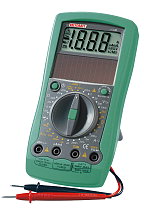
Another alternative if you are on a limited budget is a simple digital multimeter. Available from just £5, a digital multimeter can be used to measure the voltage of your battery bank, and the current (amps) being put into or drawn from the batteries when being charged or under load.
Probably the best known battery system monitor is the Bogart Engineering Tri-Metric 2020 Battery System Monitor. This device displays battery voltage, amps, amp-hours, battery percent full, and five other data functions, and works with systems from 12V to 48V for around £100. Great value as it costs the same as one decent battery and should increase the lifetime of your batteries:
Bogart Engineering have now introduced the new PentaMetric Battery Monitor which offers even more capability than the TriMetric.
Another alternative if you are on a limited budget is a simple digital multimeter. Available from just £5, a digital multimeter can be used to measure the voltage of your battery bank, and the current (amps) being put into or drawn from the batteries when being charged or under load.
Shunt Regulator
A Shunt Regulator is a small electronic component that clamps a power supply voltage at a fixed level. Hundreds of times per second it checks the power supply voltage, and if the voltage is over the limit (set by adding a couple of resistors to the regulator in a small circuit) then the extra voltage is bled off through a resistor. If the voltage is below the fixed maximum, then no current passes through the resistor.
How can shunt regulators be useful to alternative energy generators. Well, for example a solar panel rated at 12V will actually generate up to 20V. If this panel is to be connected directly to equipment requiring an input of 12V, that equipment could be damaged if the voltage is too high. Therefore, by passing the solar panel's generated current through a shunt regulator circuit, the voltage reaching the equipment can be clamped at 12V very accurately.
Rather than dumping the excess power into a resistor and losing it in the form of dissipated heat, it is possible to put it to better use, for example to heat or pump water.
A common shunt regulator used in solar applications is the LM431. This is a 3-terminal adjustable shunt regulator which can have its output voltage set to any value between 2.5 and 36V by the correct selection of two resistors. LM431's are available for example from eBay at just $4.50 for 25.
http://www.reuk.co.uk/Shunt-Regulator.htm
How can shunt regulators be useful to alternative energy generators. Well, for example a solar panel rated at 12V will actually generate up to 20V. If this panel is to be connected directly to equipment requiring an input of 12V, that equipment could be damaged if the voltage is too high. Therefore, by passing the solar panel's generated current through a shunt regulator circuit, the voltage reaching the equipment can be clamped at 12V very accurately.
Rather than dumping the excess power into a resistor and losing it in the form of dissipated heat, it is possible to put it to better use, for example to heat or pump water.
A common shunt regulator used in solar applications is the LM431. This is a 3-terminal adjustable shunt regulator which can have its output voltage set to any value between 2.5 and 36V by the correct selection of two resistors. LM431's are available for example from eBay at just $4.50 for 25.
http://www.reuk.co.uk/Shunt-Regulator.htm
Subscribe to:
Posts (Atom)